Home › Health › Tissue Biology & Dermal Health
Health · Skin science5 min read · 15 Nov 2026
Why Skin Begins Looking Different After Menopause: ABC Top 100 Scientist On The 3 Hidden Enzymes Conventional Skincare Misses

AS FEATURED IN


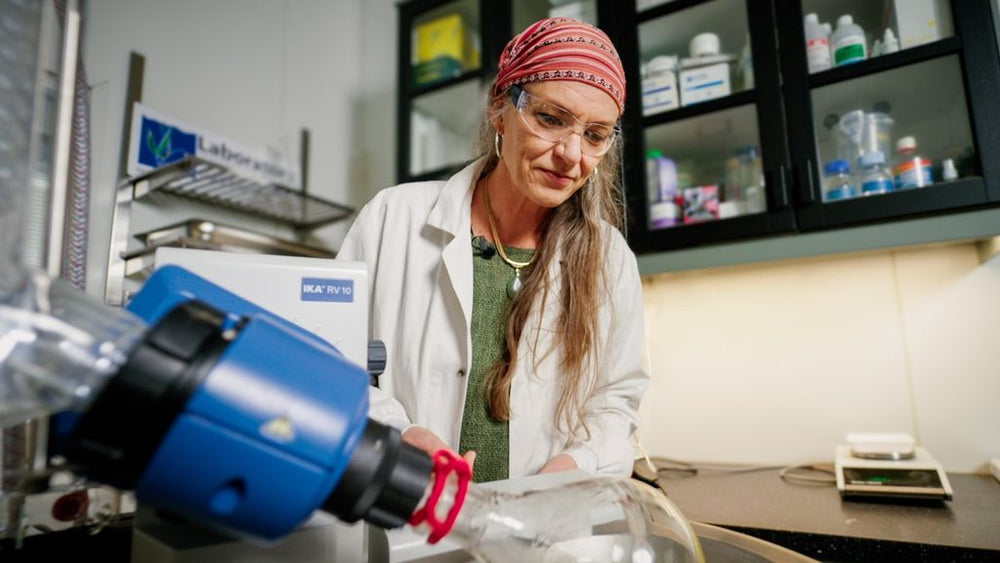
Before a horrific laboratory accident tore away a large part of my scalp in 2019 and forced me to rebuild my skin barrier from complete zero, I had already spent 25 years studying the resilient biology of Australian ocean plants.
I will explain what that hospital reconstruction revealed about mature skin in a moment.
But in my late 40s, something else caught my attention in the mirror, and in the hundreds of letters reaching our coastal research lab:
The sheer speed at which mature skin changes once estrogen levels begin to drop.
- Fine lines around the eyes and lips that were barely noticeable suddenly settle into deep expression creases.
- The skin across your cheeks, neck, and chest turns thin, fragile, and crinkles like tissue paper.
- And the firm line along your jaw begins to slacken and droop.
Most frustrating of all, the face creams you have relied on for decades suddenly stop working. You smooth on a thick layer in the morning, yet by midday, that tight, parched, stinging sensation creeps right back.
Most women blame themselves. They assume their skin is simply “getting old,” or that they need an aggressive chemical peel, harsh retinol, or five different bottles for five different areas.
(And no, buying an even heavier $150 department store night cream won't fix this either, as you will see in thirty seconds).
What our laboratory research revealed is that mature skin does not fail because you aged.
It changes because dropping estrogen wakes up three specific, hidden enzymes inside your skin that were never active in your 30s.
Enzymes that literally chew through your natural hydration and collagen before your skin cells can ever use them.
The 3 “Attacker Enzymes” Chewing Through Your Skin's Moisture Framework
To understand why your skin changed so suddenly, you have to look beneath the surface.
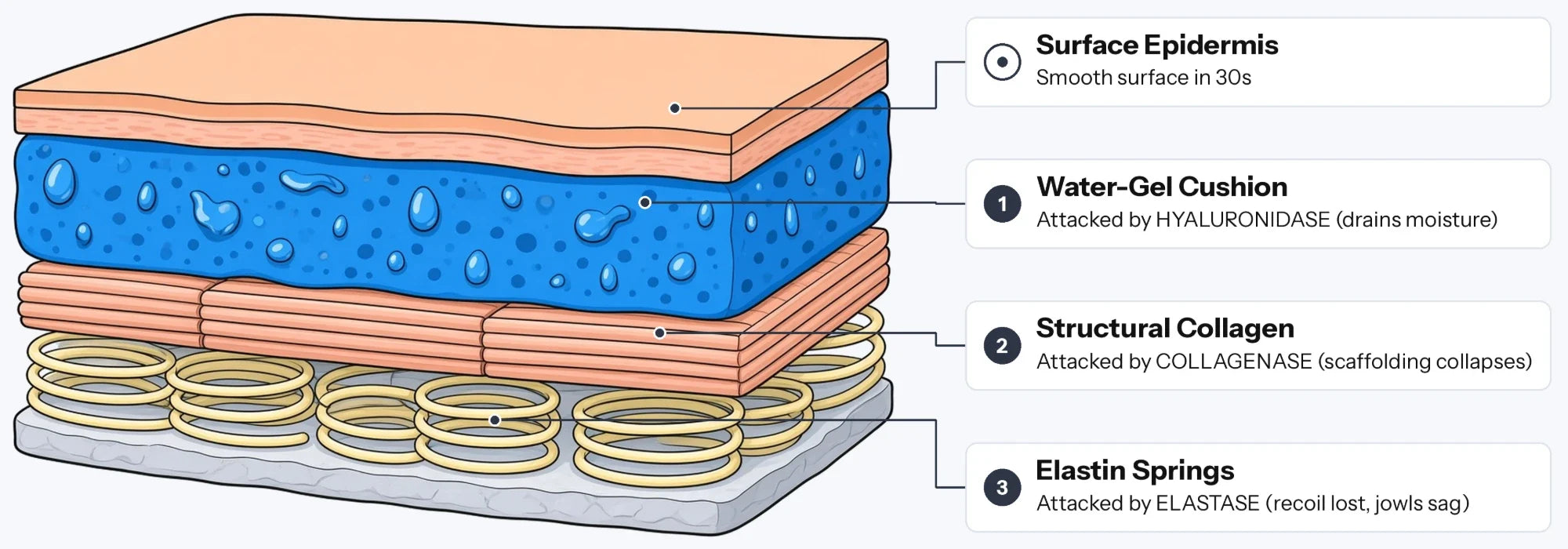
In your 30s, your skin maintains an internal water cushion. Think of it like a full, wet kitchen sponge. When that sponge is holding water, it is springy, dense, and bouncy. It pushes outward against your surface cells, keeping everything stretched smooth and flat.
That fullness is maintained by three core biological building blocks:
- 1Hyaluronic Acid: The water-holding gel that keeps living cells plump.
- 2Collagen: The deep structural scaffolding that holds your facial contours lifted.
- 3Elastin: The microscopic springs that let your skin snap back after you smile or frown.
When you enter perimenopause and menopause, estrogen drops. And that hormonal shift pulls the trigger on three aggressive enzymes that start dismantling those exact building blocks:
Destroyer #1: Hyaluronidase
Attacks the water-gel cushion
Hyaluronidase dissolves hyaluronic acid. In mature skin, it becomes hyperactive, breaking down natural moisture molecules from the inside out. By age 50, most women have lost over half their natural hydration capacity to this one enzyme alone.
(And yes, this is why that $140 hyaluronic acid serum you tap on every morning seems to vanish within two hours: hyaluronidase digests it before your cells can use it).
Destroyer #2: Collagenase
Attacks structural collagen
Collagenase actively targets and chews through structural collagen. In the first five years of menopause alone, dermatological studies show women lose up to 30% of their skin's collagen. As collagenase dismantles the scaffolding underneath, shallow surface lines collapse into permanent smile lines & lip lines.
Destroyer #3: Elastase
Attacks the elastin springs
This is the enzyme almost nobody talks about, but it is the one responsible for the change women find most distressing. Elastase attacks elastin, the protein that gives skin its bounce. When elastase breaks your elastin springs, your skin loses its recoil. The tissue along your jawline begins to sag into jowls, and the skin across your neck and cheeks crinkles into crepe paper.
Why Standard Creams Cannot Fix This
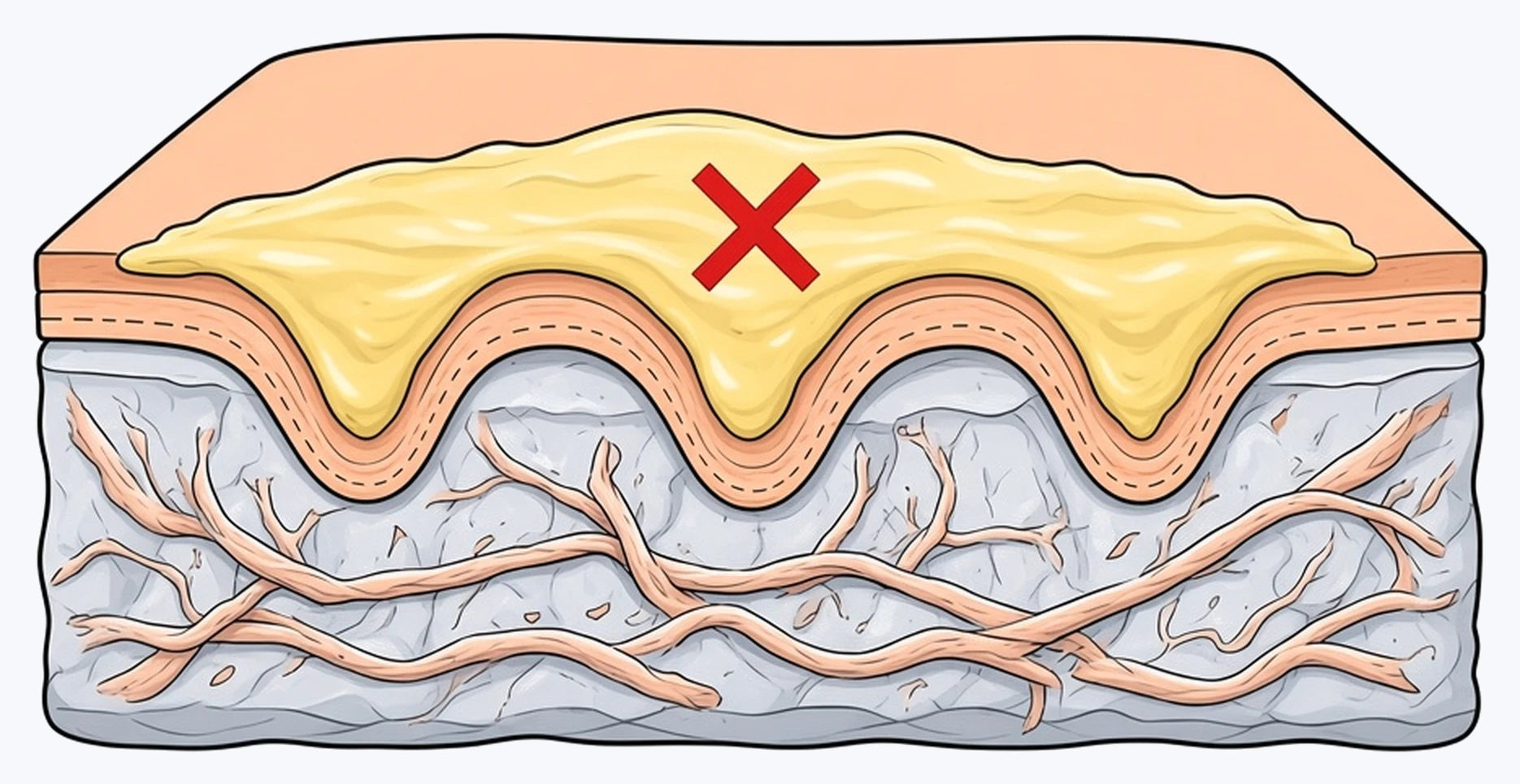
Once you see these three enzymes at work, you understand why conventional skincare fails so miserably after 45.
Most creams are made of water, mineral oils, and synthetic fillers that merely sit on the dead surface cells. They give you a temporary greasy slip for an hour, but they cannot replace the internal water cushion that enzymes are chewing away underneath.
It is like trying to fill a water bucket with three massive holes in the bottom.
Unless you block those enzymes and seal your moisture barrier with something they cannot break down, your skin will continue to dry out by lunchtime every single day.
Which brought our research team to an unexpected question:
If human skin struggles to fight these enzymes alone, where in nature does a living organism face these exact same stresses and survive?
The answer was sitting right off the rocks of our South Coast beaches.
What An Australian Ocean Plant Does To Survive That Human Skin Desperately Needs
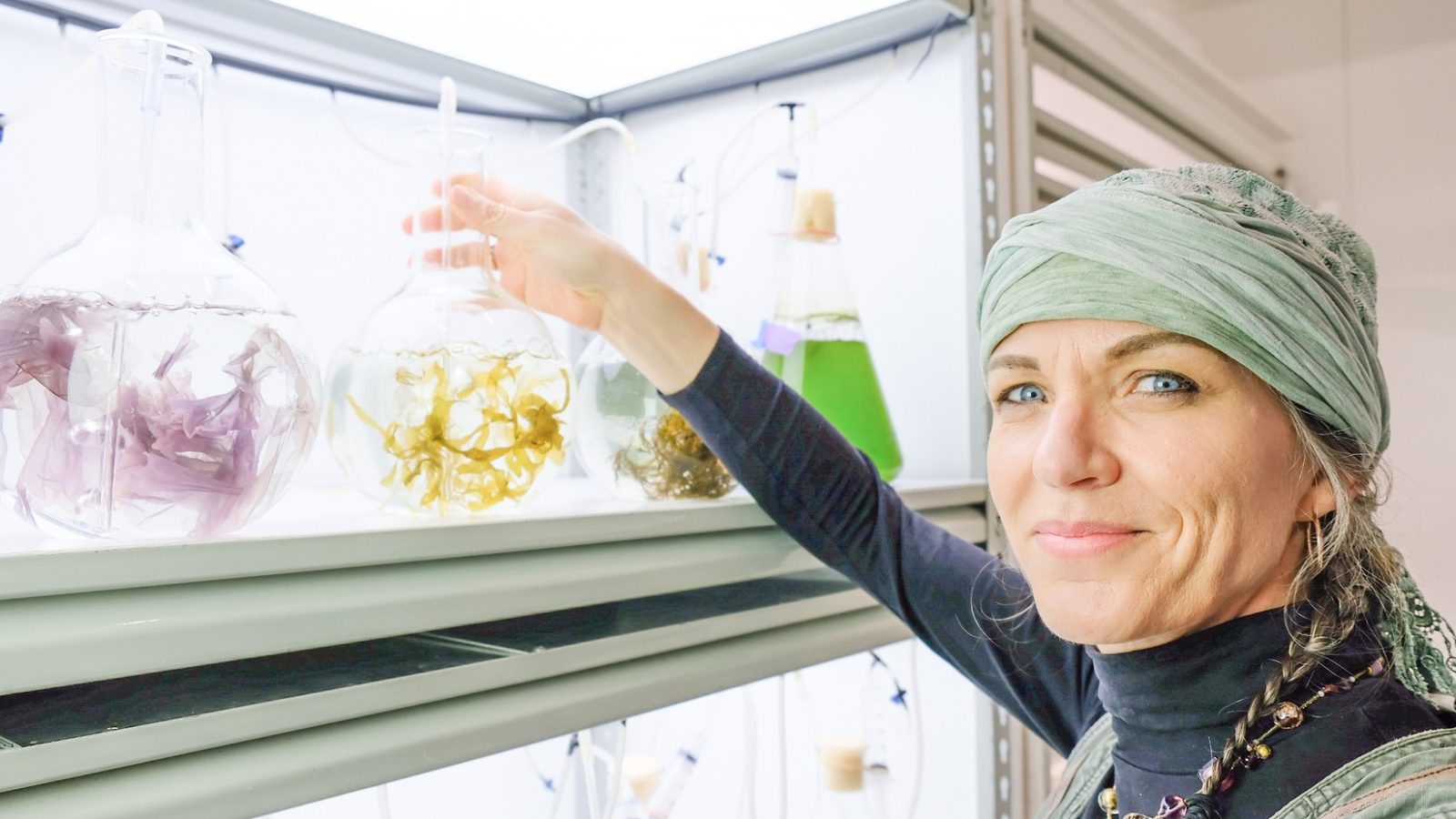
For 25 years, my team and I had been studying a unique group of molecules found in native Australian seaweed called marine polysaccharides.
Out on the South Coast rocks, native green seaweed survives extreme environmental stress: baking sun, drying winds, and salt water that would dehydrate any land plant within hours.
To survive, the seaweed produces a specialized marine gel network that binds moisture and protects its delicate cellular structure from breaking down.
When we analyzed this marine gel under high-powered microscopy, what we saw amazed us:
Its molecular structure mirrors human skin's connective tissue so closely that living cells actually recognize it as their own.
We developed a pure extraction method from this native seaweed, creating an active marine complex we named Phyaluronic® (with a ‘P’ for Phyco, meaning seaweed).
Unlike standard lab-synthesized hyaluronic acid, which holds 1,000 times its weight in water, Phyaluronic® binds up to 2,000 times its weight in water (double the hydration capacity).
More importantly: because of its ocean-hardened plant structure, skin enzymes cannot easily digest it.
It forms an enzyme-resistant ocean shield over your skin, locking in deep surface moisture while protecting your deeper collagen and elastin framework.
The 4-Hour University Test That Stunned Our Research Team
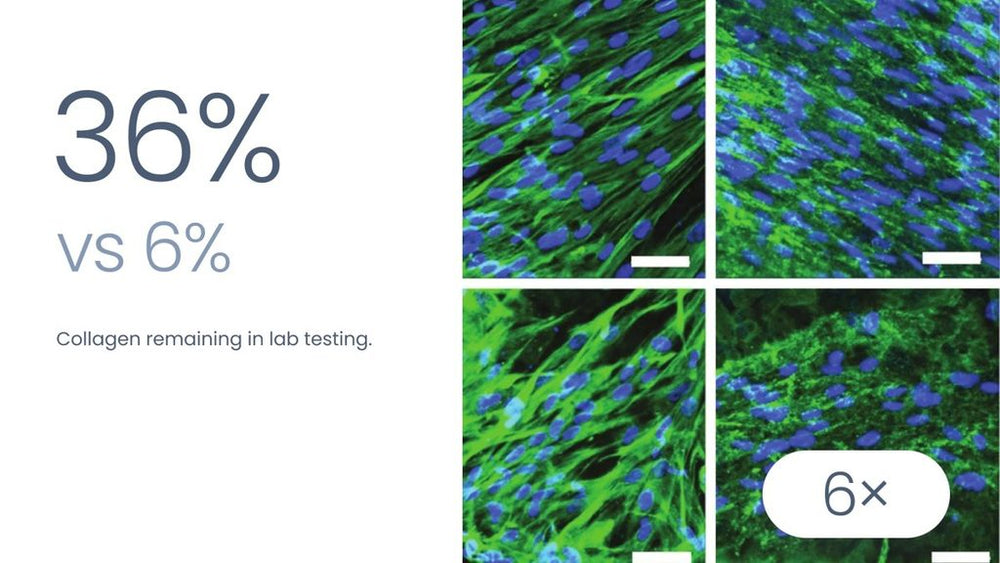
To test this mechanism under strict laboratory conditions, we collaborated with researchers at the University of Wollongong.
In a controlled experiment, living collagen structures were subjected to aggressive enzymatic attack for four continuous hours.
One sample contained ordinary collagen alone.
The other contained collagen protected by our native seaweed complex (Phyaluronic®).
Here is what the microscope showed:
Controlled laboratory enzyme trial conducted at the University of Wollongong, testing collagen preservation under enzymatic degradation.
When ordinary collagen was attacked, 94% of its structure dissolved.
But when shielded by our seaweed molecule, six times more structural collagen remained fully intact.
We had proven that this marine active did not just hold an extraordinary amount of water; it physically helped defend the skin's structural frame from enzyme breakdown.
We had the clinical data.
Yet I never anticipated that the ultimate proof of this discovery would be tested on my own severely wounded skin just months later.
A Horrific Laboratory Accident, Six Surgeries, And A Skin Graft Tested From Complete Zero
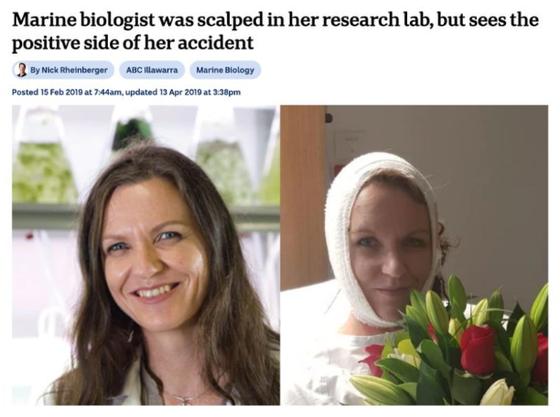
In February 2019, this research became deeply personal to me.
Early one morning, I was working alone in my South Coast lab checking the filtration unit on an experimental batch of wound-healing seaweed extract.
A piece of high-powered machinery caught my hair. In a fraction of a second, a massive section of my scalp was torn completely away, and I lost half my blood volume.
Six reconstructive surgeries followed, along with a major skin graft taken from my thigh to rebuild the destroyed tissue on my head.
The irony was painful: I was literally making skin-repairing seaweed extracts the exact second my own skin barrier was ripped away.
Lying in hospital, I knew I could not rely on standard chemist creams packed with petroleum oils, mineral greases, and artificial fragrances that sting and irritate wounded tissue.
 Before
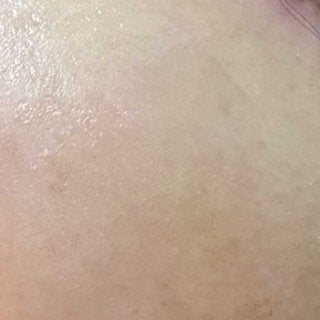 After
So alongside my medical care, I began applying our seaweed formulations directly to my healing skin graft.
I watched as the gentle marine gel calmed severe redness and surface stinging within hours, forming a breathable, protective seal over raw, fragile new tissue. It provided the exact biological environment my living cells needed to survive, anchor, and rebuild a destroyed moisture barrier from zero.
If this native ocean molecule could protect and help restore surgically grafted skin after six major operations, imagine what it could do for the everyday smile lines & lip lines, crepey dryness, and loss of firmness on your face.
That recovery changed my life. And it changed the direction of our company forever.
From Clinical Wound Care To A Daily Restorative Barrier Cream
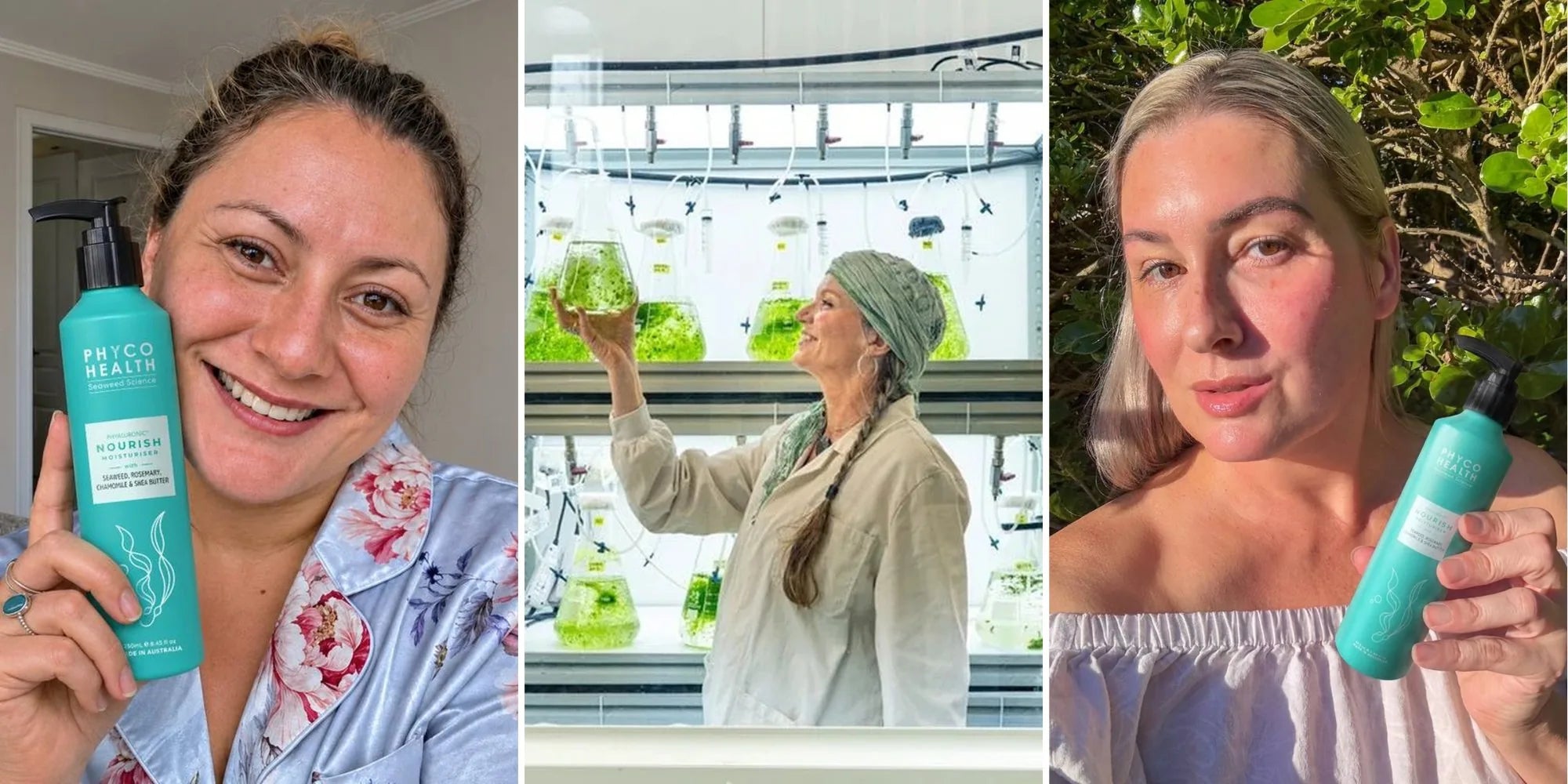
That clinical recovery led directly to the creation of Phyaluronic® Resist Moisturiser (known to our community as Nourish).
We formulated this rich, buttery cream around our pure seaweed extract to give mature skin a 48-hour locked moisture shield that enzymes cannot digest.
Unlike heavy chemist creams that suffocate your pores or rub off on your pillowcase, its marine polysaccharides sink directly into living skin cells in under two minutes, leaving your face velvety, calm, and deeply hydrated with zero greasy residue.
And because mature skin changes do not stop at your chin, we packaged it in a generous 250ml airtight aluminium pump bottle (five times the size of standard creams). You have plenty of rich, face-grade marine hydration to smooth crepey skin and dry lines across your face, smile lines & lip lines, neck, decolletage, and hands without rationing.
What Happens Over 48 Hours, 2 Weeks, And 60 Days
Real biological repair takes time, and I will never promise overnight magic. But because Phyaluronic® creates an immediate protective ocean shield that enzymes cannot digest, the progression happens in clear stages:
- In the first 48 hours: That tight, itchy, parched feeling simply stops happening. Your skin stays comfortable and calm past lunchtime, with zero midday tightness or stinging.
- By day 14: As your surface moisture barrier seals, microscopic roughness and flaking disappear. The delicate skin around your smile lines & lip lines and eyes looks visibly softer, plumper, and more rested.
- Over 30 to 60 days: With your structural collagen and elastin continuously protected from enzymatic breakdown, deeper changes emerge. That papery, crepey texture across your neck, chest, and cheeks smooths out, and the skin along your jawline feels noticeably firmer and more resilient.
What Australian Women Are Saying
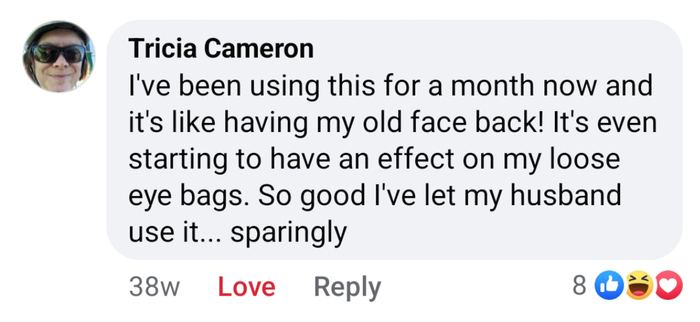
Over 100,000 bottles have been delivered across Australia, and 98% of reviewers say they would recommend it to a friend.
Here is what women are saying after adding Phyaluronic® Resist Moisturiser to their nightly routine:



A Final Note From Dr. Pia Winberg
When I first began researching Australian seaweed more than 25 years ago, I never imagined that a horrific laboratory accident would lead me to rethink mature skincare entirely.
What that recovery taught me is that caring for your skin as you get older is not about chasing aggressive clinic procedures or hiding behind greasy creams that sit on top of dead cells.
It is about understanding your underlying biology.
When your estrogen levels shift, three enzymes wake up and start destroying your natural hydration, collagen, and elastin. When you give your skin an ocean molecule that blocks those enzymes and holds water where living cells need it, your skin barrier can finally repair itself.
You are going to apply a moisturiser tonight either way.
You can use a standard chemist cream that feeds those enzymes, or you can use the clinical formula built specifically for the skin you have now.
Because we cultivate our seaweed in small, controlled batches along the South Coast of New South Wales, our supply is naturally limited.
And I want you to feel completely comfortable trying it on your own skin, which is why we back every bottle with our 90-day empty-bottle guarantee:
Use Phyaluronic® Resist Moisturiser every evening for three full months. If your skin is not noticeably calmer, softer, and more hydrated, simply email our South Coast team and we will refund your purchase in full. Keep the bottle. There is nothing to send back.
Dr. Pia Winberg, PhD · Marine Scientist & Founder, PhycoHealth · Shoalhaven, New South Wales