Home › Health › Tissue Biology & Dermal Health
Health · Skin science5 min read · 13 Nov 2026
Why Skin Begins Looking Different After Menopause: ABC Top 100 Scientist On What Conventional Skincare Misses

AS FEATURED IN


For more than 25 years, I've dedicated my career to studying Australian seaweed.
My work as a marine scientist has taken me from studying how seaweed grows and survives to researching how its unique biology interacts with human tissue.
And as I entered my late 40s, I became increasingly focused on what happens to women's skin during menopause.
Because for many women, the changes seem to come surprisingly quickly.
- Fine lines that were barely noticeable become more pronounced.
- The skin around the eyes, cheeks and neck starts looking thinner and crepier.
- And that smooth, plump appearance we've had for years begins to fade.
Even women who have taken good care of their skin can find that their usual moisturizers and serums no longer seem to give them the same results.
And I wanted to understand why so many of these changes seemed to appear together.
So I began looking more closely at what actually changes in the skin as estrogen levels decline.
And what I found suggested there was another important piece to the problem that most women weren't being told about.
To understand it, we have to look at something happening beneath the skin's surface that gets almost no attention.
Why do fine lines, crepey skin, and dryness all arrive in the mirror at the exact same time?
Most people think of skin firmness almost entirely in terms of collagen.
We are told from our twenties onward that collagen is the most important thing for our skin, and that as we get older, it gradually breaks down.
While it does matter, collagen isn't the only thing that gives your skin that smooth, glassy fullness.
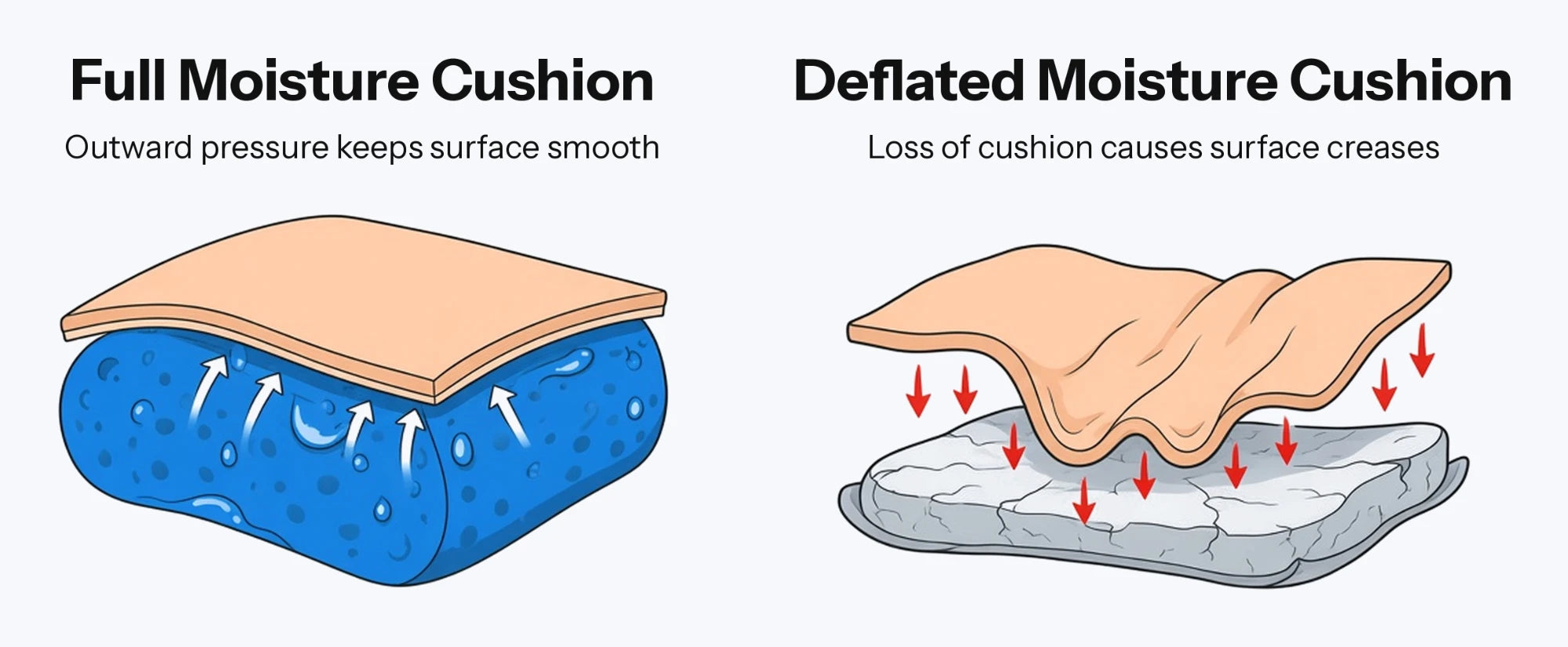
Underneath the surface, healthy skin is naturally filled with a gel-like water substance that helps keep the surrounding tissue hydrated and supple.
Think of it like the filling inside a cushion.
The collagen provides much of the structure, while the water-gel held between those fibers helps give skin its soft, plump appearance.
When there's enough moisture, the skin looks fuller. Tiny surface creases are less noticeable, and the skin has that smooth, healthy-looking finish.
But as estrogen levels decline during menopause, the skin's ability to produce and maintain that natural water-gel decreases.
And when skin begins losing that water-gel, the effects show up in several ways:
Less moisture stays inside the skin. The internal hydration layer begins to shrink. And the surface of your skin gradually loses the outward pressure that was keeping it smooth.
Once you understand that, the changes women notice in the mirror start making sense.
Because that single loss of water shows up in four distinct ways:
- 1First, the surface becomes drier, because there is less moisture rising up to hydrate the outer cells.
- 2Second, shallow creases that used to bounce back begin settling into visible fine lines, because there is less water volume beneath them to keep the surface stretched flat.
- 3Third, when enough of that internal fullness disappears, the skin starts crinkling into that thin, papery, crepey texture across the cheeks, neck, and jawline.
- 4And fourth, skin loses that fresh, smooth, luminous glow.
That's why dryness, fine lines, crepiness and loss of radiance can seem to arrive together during menopause.
And once I understood how important that water-gel environment was, it raised another question:
Why are so many women still struggling with dry, crepey-looking skin when they are already using moisturizers every day?
Why a thicker moisturiser just sits on top like wax on a flat balloon
The problem isn't that moisturizers don't work.
In fact, most do exactly what they're designed to do.
They soften the skin's surface temporarily.
But that doesn't necessarily improve the changes happening with mature skin.
A heavy cream might make your face feel softer and more comfortable for a few hours.
Yet those fine lines can still be there. The crepey texture may still show. And your skin can still look flatter and less luminous than it used to.
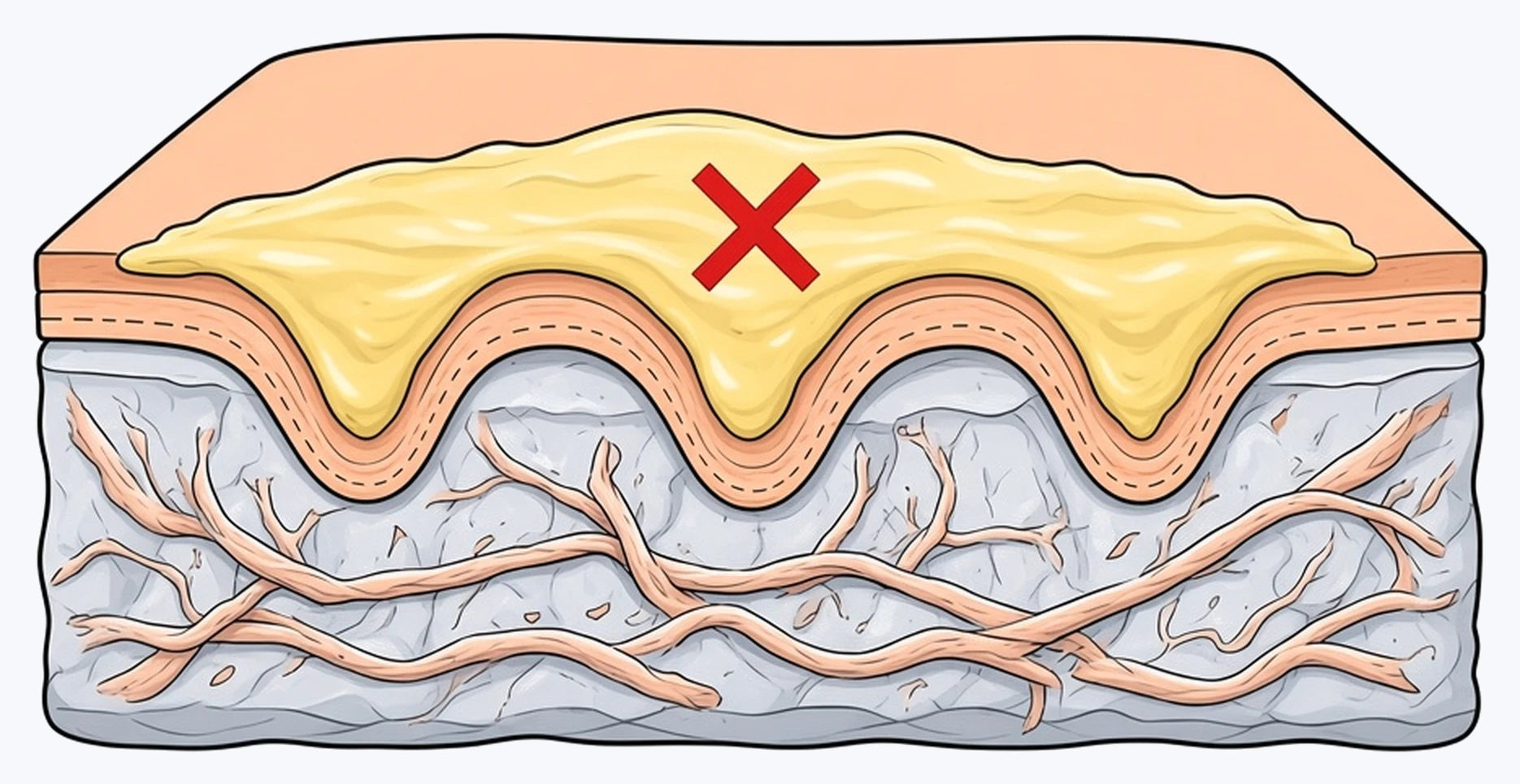
That's because putting heavier, greasier moisturizers on your face lubricates the surface momentarily, but your skin enzymes break them down fast, and they fade off without supporting the natural hydration layer.
And simply applying a thicker layer of cream doesn't make up for that difference.
This was the part I became particularly interested in.
If the ability to hold onto water was so important to how skin looked and felt, then I wanted to understand what could help improve that moisture retention.
And as I looked into it more closely, I began to see a connection with the unusual properties of certain molecules found in Australian seaweed that I'd spent decades studying.
That placed me right at the intersection of two areas I'd become deeply interested in: the biology of menopausal skin and the marine molecules I'd spent much of my career researching.
And it led to a discovery that changed how mature skincare is understood today.
What an Australian ocean plant does to survive that human skin desperately needs
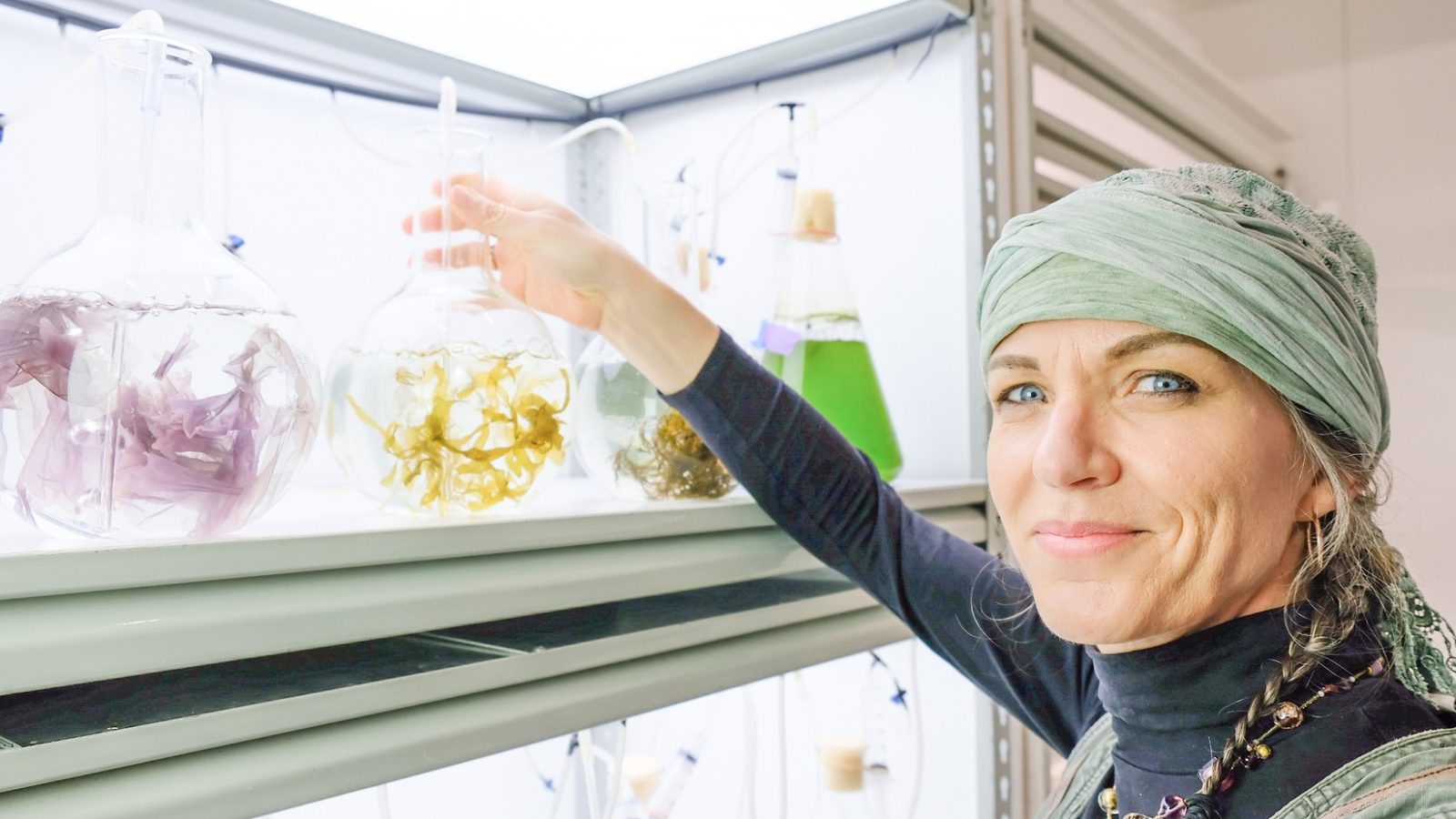
For years, my team and I had been studying a group of unusual molecules found in Australian seaweed.
They're called marine polysaccharides: long chains of natural sugars that help seaweed manage water and survive in its environment.
Out in the ocean, native green seaweed survives baking UV rays and drying salt by producing a unique marine gel that protects its structure and binds an extraordinary amount of water.
What amazed us was how identical this gel-like network was to human skin’s connective tissue.
Given what we'd learned about the water-gel decrease during menopause, we began to see how useful these water-binding properties could be for mature skin.
Instead of relying on a thicker, heavier cream that just fades off, we could use the water-binding properties of these marine molecules to support that natural hydration layer.
And there was something else about this material that made us want to investigate it further.
Because when we began studying how it behaved alongside collagen and human skin cells, we found that its abilities went well beyond holding water.
The University of Wollongong trial that preserved six times more collagen
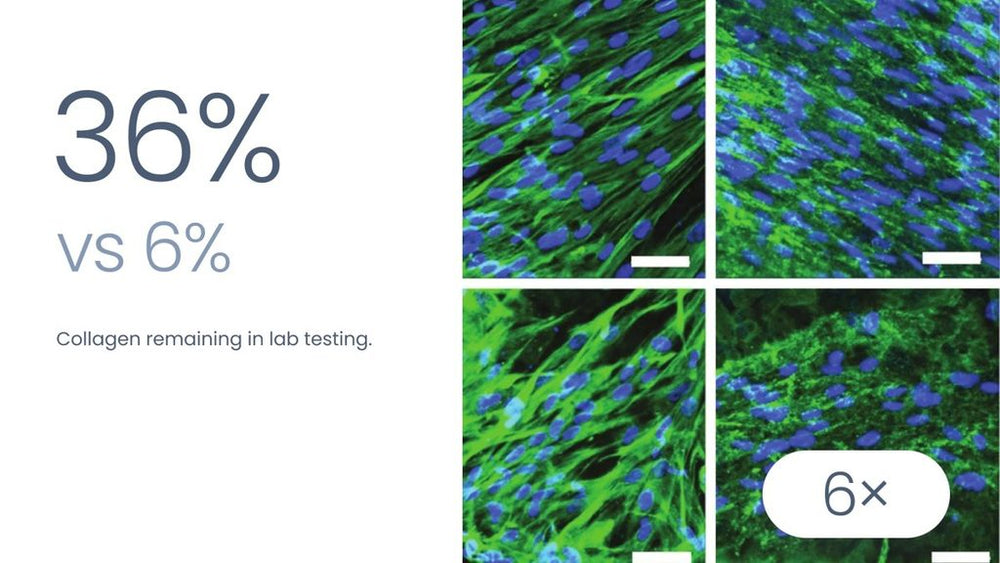
At the University of Wollongong, we studied how the seaweed molecules behaved alongside collagen and living human skin cells.
In one laboratory experiment, we exposed two collagen structures to a skin enzyme that breaks collagen apart.
One contained ordinary collagen.
The other contained collagen combined with our seaweed molecule.
After four hours, approximately 94% of the ordinary collagen structure had broken down. Only 6% remained.
But when our marine molecule was added, 36% of the collagen structure was still intact.
University of Wollongong laboratory experiment, as described by Dr. Winberg.
This finding revealed something we hadn't initially expected.
The seaweed material wasn't only unique for its ability to hold water. It was also helping support and protect the structural collagen framework underneath.
Then in 2019, this research became deeply personal to me.
A horrific industrial accident, six surgeries, and a skin graft tested from complete zero
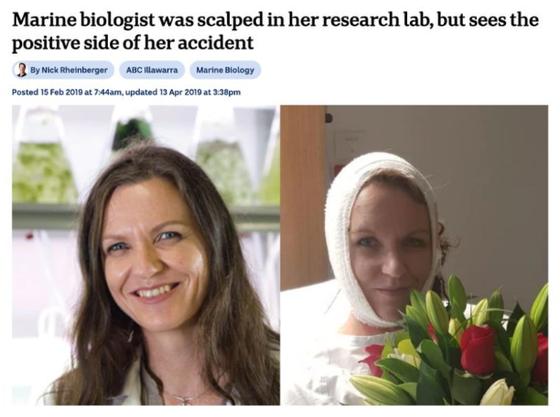
In February of 2019, I was working in our South Coast laboratory when I suffered a terrible accident.
A piece of machinery caught my hair and tore away a large section of my scalp and I lost half my blood volume.
Over the months that followed, I underwent six reconstructive surgeries.
This is when the research I'd been doing with skin cells and seaweed molecules was no longer something I was just studying in the laboratory.
It became a part of my own recovery.
 Before
 After
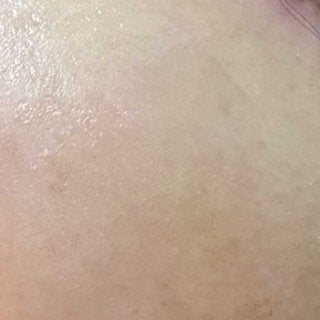
During my recovery, I began using skincare formulations from our seaweed research alongside my medical treatment.
Seeing my own skin go through such an extensive reconstruction gave me an entirely different appreciation for how complex skin repair really is.
It strengthened my determination to understand what our findings could contribute to skin health.
The seaweed research that had defined my career was no longer just my work...
It took on a whole new meaning.
Translating a hospital wound-healing extract into an everyday morning and evening protocol
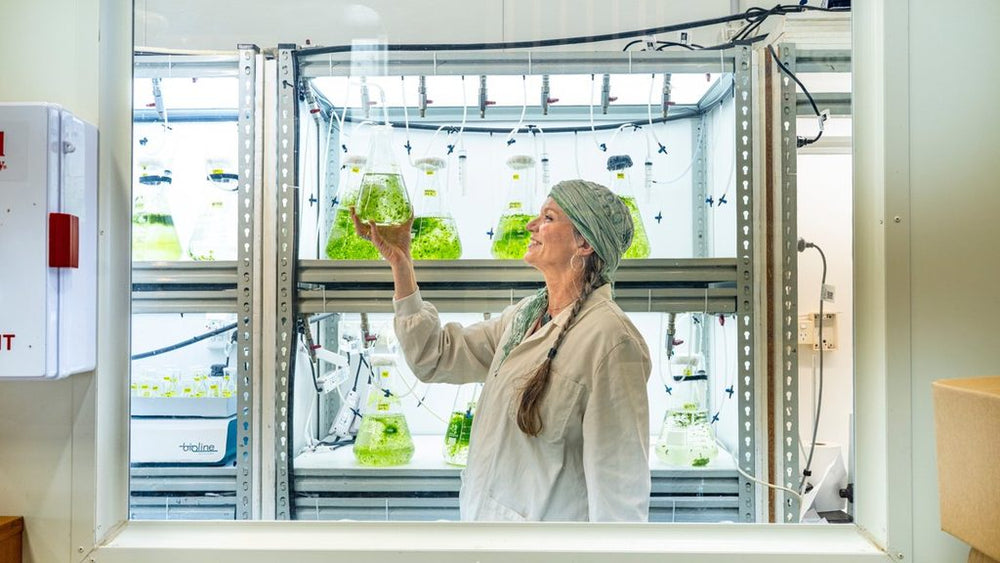
And it was this combination of scientific research and personal recovery that eventually led our team to develop Phyaluronic®.
After years of studying and testing seaweed molecules, we turned what we'd learned into something women could use as part of their daily skincare.
Phyaluronic® is a patented complex of the same Australian seaweed molecules I'd used during my recovery.
Rather than just lubricating the surface, it supports the hydration layer that makes skin look smooth, glassy and healthy, while helping retain the collagen structure.
So we formulated a high concentration serum, designed to bring those water-gel abilities into a simple, everyday skincare treatment.
Most anti-aging serums contain only 1% active ingredient. We made ours 50% pure active
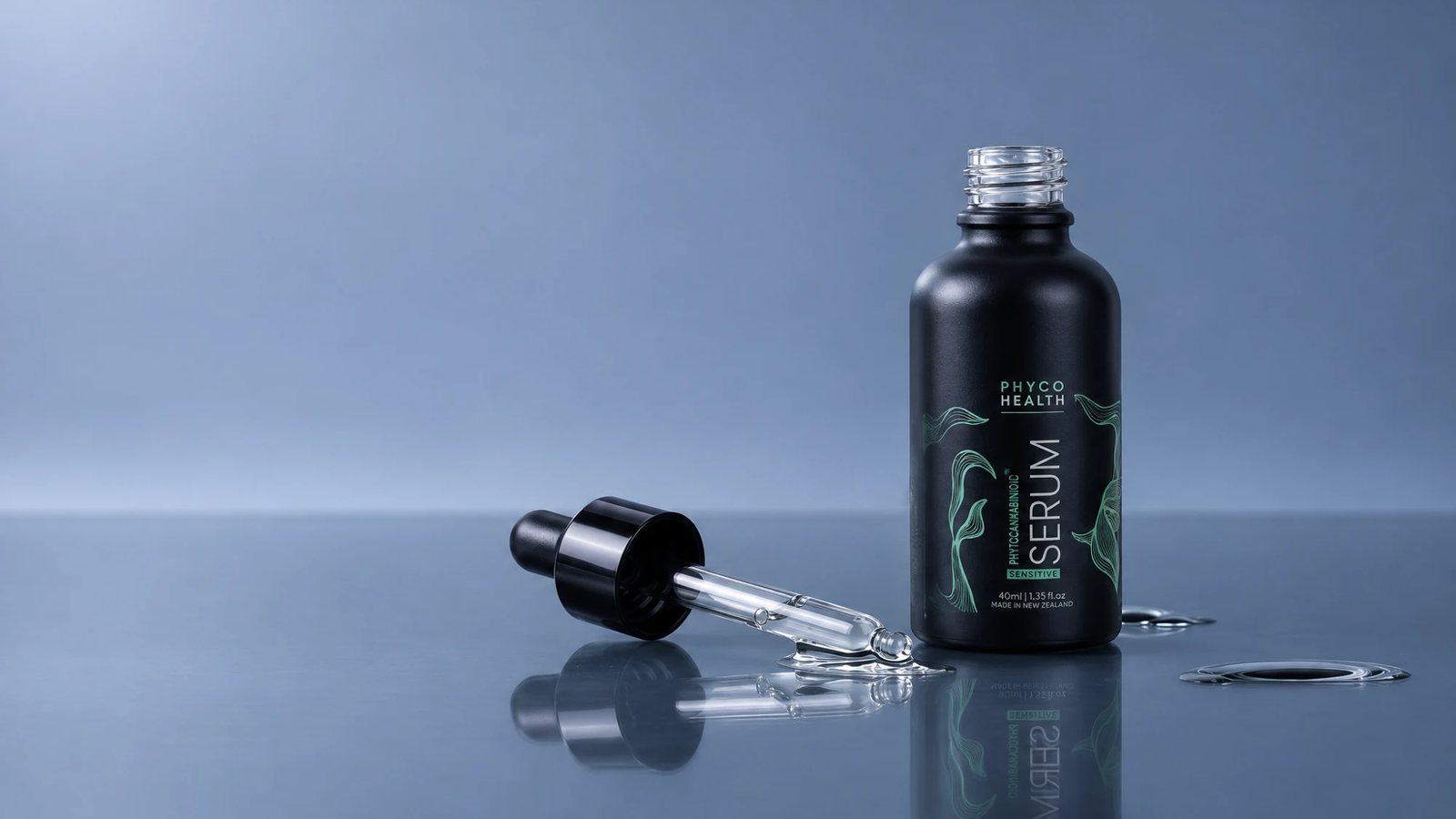
That became BIOMEBALANCE Phyaluronic® Serum.
What mattered to me wasn't just having our marine molecule available in this formula; it was making sure there was enough inside the bottle to actually make a difference.
Most conventional skincare formulas contain only a small percentage of their main active ingredients, often around 1 to 5%. The rest is mostly water, thickeners, and filler.
We formulated the Phyaluronic® Serum with a full 50% concentration of our active seaweed complex.
That means half the formula consists of the pure marine molecule we've spent decades researching.
And we chose that concentration for a reason.
We wanted to make the water-binding properties of Phyaluronic the foundation of the formula, rather than adding a token amount to an ordinary moisturizer.
Despite its high concentration, the serum is clean, lightweight, and easy to apply.
Two drops spread across clean skin forms a thin, highly hydrated layer that soaks straight in, without the heavy, greasy feeling of ordinary moisturizers.
And because its nature mirrors human connective tissue, skin enzymes don't break it down like regular moisturizers, keeping that hydration plumping your skin tissue all day.
No midday tightness, softer smile lines & lip lines, and waking up with natural morning bounce
Of course, what's important isn't how interesting a molecule looks under a microscope. It's what happens when you actually use it on your skin.
And that's where the Phyaluronic® Serum makes a tangible difference.
For women whose skin has become drier and less supple around menopause, the first thing you notice is how comfortably the skin stays hydrated.
That tight, dry feeling by midday can stop happening as the surface retains moisture.
Over the next weeks, as that moisture keeps plumping the tissue, skin that once looked dull and dry takes on a fresher, more luminous, glassy appearance.
Over two to three months, as the skin hydration and collagen is protected consistently:
- Those fine dehydration lines around the eyes look softer and more rested.
- The skin along your jawline feels firmer and more resilient.
- That thin, crepey texture on your cheeks and neck can smooth out.
Applying the serum takes less than ten seconds.
Just two drops every evening onto clean skin.
What women are saying
You don't have to take my word for it as a scientist. Here are a few unprompted notes women have left under our posts, usually a few weeks in, once their skin starts holding its cushion again:




A Final Note From Pia
When I first began studying Australian seaweed more than 25 years ago, I never imagined where that research would eventually take me.
From studying marine biology to researching human tissue, and eventually through my own reconstruction, it has been a journey that changed my understanding of skin completely.
And one of the most important things I've learned is that caring for our skin as we get older doesn't mean turning back the clock or buying ten different products for five different symptoms.
It's about understanding what our skin actually loses, and giving it the biological environment it needs to stay supple, hydrated, and resilient.
That's what led us to develop Phyaluronic.
Because we cultivate our seaweed in small, controlled batches along the South Coast of New South Wales, our supply is naturally limited.
And I want every woman to feel completely comfortable trying it on her own skin, which is why we back every bottle with our three-month guarantee.
Use it consistently for ninety days. If your skin isn't noticeably plumper, smoother, and more hydrated, simply email our South Coast team and we will refund your purchase in full.
Because while we can't stop the changes that come with age, we can find better, smarter ways to care for our skin through them.
Dr. Pia Winberg, PhD · Marine Researcher & Founder, PhycoHealth